The Ten Percent Solution

With talent comes an immediacy; an ability to draw something up from the pool that resides within. It’s not always perfect or exactly what we want; it’s about 90%. Looks pretty good. The key to producing something that will make your audience sit up and take notice is in doing what it takes to make that last ten percent. Sometimes it can be very difficult because you must be brutally honest with your assessment. It might even require an outside critique; the scariest of all tests. But!

How do you get that last ten percent? There is no formula; step one step two… that will fit every situation. You must formulate your own guidelines for making that last mile of the journey. Talent is yours; you can enhance it but you can’t substantially change it. Editing what we produce is the key. Learn to edit and you will be gaining ground every time.

Photography & Recognition – 7 Things

Want to be a great photographer? Want to have that feeling of recognition? I think we all do at least on some level. It’s really true for all the creative disciplines. You can substitute Photographer with your particular gift.

So what are the components to gaining recognition whether it be simple approval or financial reward. I’m speaking of photography here but you can adjust this to fit your own situation. Rinse, repeat and see what works for you. Starring in no particular order.

  1. Talent – Huge! You either have talent that fits your goals or you don’t. Everyone has talent but it’s usually limited to certain areas.
  2. Wit – Whether it’s the ability to see irony or be quick with a line or a joke, this trait will enhance how you are received by others.
  3. Savvy – It might be gear and tech stuff or knowing all the trends and lingo of the prevailing social culture.
  4. Personality – The type of personality you have will greatly affect your relationships with clients and coworkers. Hard to categorize but a huge factor in photographing people.
  5. Tenacious – Stick with it. If you feel like quitting. Take a break and start again. Without it you won’t finish anything.
  6. Patient – Real growth, progress takes time. Don’t rush it.
  7. Hard Working – The reason people succeed is by working very hard. When asked what qualities are necessary for succeeding in photography, two top pro’s said they look for someone with a good work ethic.

None of these thing are about cameras and lighting. You can become a competent photographer and successful but to be great you need the intangibles.

iPhones, Hate Mail and How we overcome

Recently my long time digital neighbor @scottbourne posted on twitter that he had received some hate mail for posting a lowly iPhone picture on his blog.

The following is not so much a rebuttal of Scott’s critics but some insights about the creative process in general and photography as a medium.

My platform for this piece is based on thirty years in the design business, dealing with people, photographing things and really looking and thinking. Thinking and looking are far more important than tools. It matters not whether you have all the latest gadgets or simply a pencil and a legal pad. Creativity is about thinking and looking.

There’s an old saying, “it’s a poor workman that blames his tools”. I must say this is very true. It’s taken a long time to realize that if my work is not what I want it to be; it’s not my computer or my camera’s fault. The skill is between my ears. I simply failed to employ everything necessary to get the job done. Sometimes you have happy accidents but you can’t rely on that to see you through.

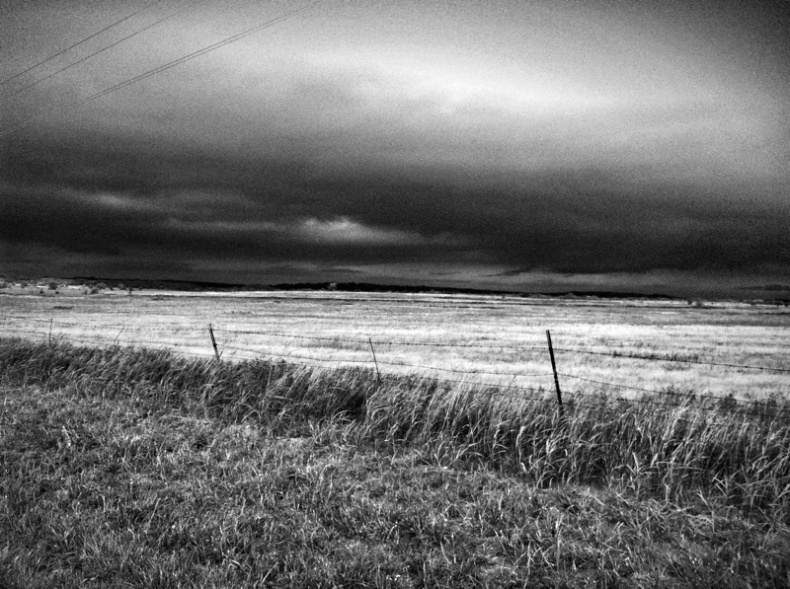
Taken w/ Blackberry Curve

In Scott’s case it seems that some folks were upset that he had used his iPhone and a simple light to create the image instead of all of his high end photo gear. He was only trying to demonstrate the capabilities of the phone and that you can make decent images without a DSLR.

When I decided to switch to digital all I had was a cell phone. What I learned from using only a cell phone can be found here.

Knowing the strengths and weaknesses of your tools is the key, the brand, label, megapixels and ratings are minor in comparison to skill, thinking and looking. Being able to “see” an image out of all the visual cacophony is right at the top of the list.

The first photo I ever sold was made on a Canon A540 point and shoot camera that I bought at a pawn shop. In fact you can’t tell what camera was used by looking at the photo.You can only analyze the physical properties of the image.

Oh Yeah, there’s One More Thing. The very nature of the creative process is based on criticism. At some point you have to say, this is good or it’s trash and I need to do better. Criticism doesn’t have to be rude or unkind but it does need to be honest. Invariably when I’ve been criticized in the past, I’ve had some of both and lived to tell about it. The notion that we are going to live in a world where people don’t have strong opinions and not voice them is frankly unrealistic. Especially if you create for a living.

Guard your subjective bias and realize there are many new tools and means of creative expression out there.

Top 11 Best DSLRs

Top 11 Best DSLRs.

This list is just something that resonated with me and gives some credit where it is due.

Enjoy!

Pro Photo Tips & Saving Money

What better combination right? Know what the pros know and save a little money too. I’m going to reveal the first and best tip I ever received from a working professional photographer and then give you an example you can put to use.

I learned this from a working photographer back in the days when it was film only and photography was an expensive hobby. Just like today there was always gear to buy and dream about; to cover all the photographic situations. So here’s the tip: You don’t have to buy the most expensive piece of gear with the latest specifications. You simply need the right tool for the job. Having a telephoto lens on the camera when a good 50 mm lens is what you need —this is the application we are talking about. It’s obvious but you can’t stop and change the lens if you don’t have the lens to change to. If you need a tripod, it’s best to have one even if it isn’t the top of the line from “Really Right Stuff” with a BH55 ballhead.

Camera lenses are a good example but the principal works with any piece of gear. Here’s how you can save on buying an 85mm 1.4 lens if you are a Nikon or Canon shooter [check for other camera compatibility] This is the Rokinon 85M N85 F1.4 lens, just under 300.00 dollars. Yes it’s not auto focus and it won’t have the same specs as the Nikkor or the Canon EF lens but it’s also not 2000.00 dollars either.

Thanks to Jeff Clow on Flickr for the Rokinon tip and Nutdanai Apikhomboonwaroot at FreeDigitalphotos.net

Follow

Get every new post delivered to your Inbox.